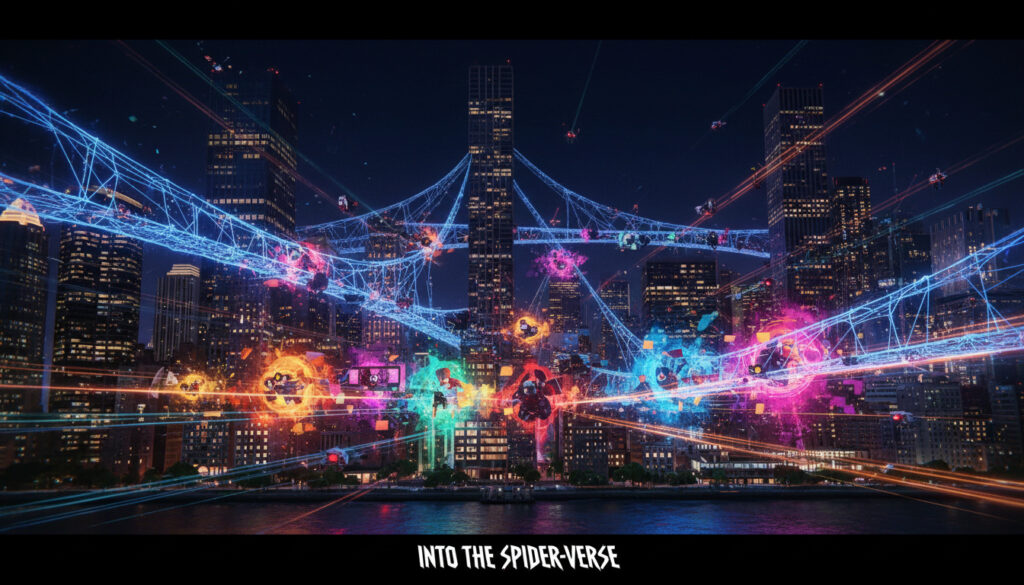
How Spider-Man: Into the Spider-Verse Redefined Comic Book Cinema
When Sony Pictures Animation released Spider-Man: Into the Spider-Verse in December 2018, the film immediately distinguished itself from decades of superhero cinema. Rather than adhering to photorealistic computer animation or live-action conventions, directors Bob Persichetti, Peter Ramsey, and Rodney Rothman embraced a radical aesthetic that translated comic book grammar—panels, dots, lines—into kinetic motion.
The Grid: Multiversal Cast
The narrative centers on Miles Morales, a Brooklyn teenager who gains spider-powers after a radioactive bite. When Kingpin’s experimental collider malfunctions, it pulls Spider-People from alternate realities into Miles’s universe:
- Peter B. Parker (Spider-Man from another dimension, weary and past his prime)
- Spider-Gwen (Gwendolyn Stacy, a drummer with spider-powers from Earth-65)
- Spider-Ham (Peter Porker, an anthropomorphic pig with cartoon physics)
- Peni Parker (an anime-inspired pilot mentally bonded with a radioactive spider)
- Spider-Man Noir (a black-and-white 1930s private investigator)
Production Insights
The film’s distinct visual approach required unprecedented technical innovation. Animation teams developed new tools to generate the “line boil” effect—intentionally offset lines that simulate hand-drawn imperfection—and frame rates that varied between characters. Miles animates on twos (12 frames per second) during early scenes, accelerating to ones (24fps) as he gains confidence, while Spider-Ham operates on exaggerated cartoon timing. Modern animation techniques rarely employ such deliberate frame rate variation, making this approach particularly distinctive.
Critical and Commercial Performance
Commercially, the film significantly outperformed its $90 million production budget. The following table summarizes key metrics:
| Metric | Figure |
|---|---|
| Production Budget | $90 million |
| Domestic Box Office | $190.2 million |
| Global Box Office | $375.5 million |
| Academy Awards | 1 (Best Animated Feature) |
Detailed box office tracking is available via industry data sources.
Technical Specifications
The runtime clocks at 117 minutes, with a color palette deliberately limited to mimic comic book CMYK printing processes. Voice talent includes Shameik Moore as Miles, Jake Johnson as Peter B. Parker, and Hailee Steinfeld as Gwen Stacy. Complete cast and crew information appears on film databases.
Development Timeline
- : Sony announces development of animated Spider-Man feature
- : Phil Lord and Christopher Miller join as producers/writers
- : Shameik Moore cast as Miles Morales
- : Official title revealed
- : Theatrical release
Visual Language Explained
The film hybridizes techniques: 3D modeling provides volume, while 2D ink lines and halftone patterns provide texture. Action sequences incorporate comic book panels and on-screen text (like “THWIP!” and “POW!”) as diegetic elements within three-dimensional space. This approach required animators to unlearn photorealistic instincts in favor of stylized poses and perspectives reminiscent of Jack Kirby and Steve Ditko artwork. Marvel’s official materials detail the artistic collaboration.
Cultural Analysis
Critical consensus positioned the film as revolutionary for the genre. The trade press noted its emotional authenticity regarding Miles’s relationships with his father and uncle, grounding dimensional-hopping spectacle in adolescent specificity. Audiences and critics agreed; review aggregators record near-unanimous praise for its innovative storytelling.
Creative Perspectives
“We wanted to make a movie that felt like you walked inside a comic book.”
— Phil Lord, co-writer/producer
“The beauty of Miles’s story is that anyone can wear the mask.”
— Bob Persichetti, co-director
Summary
Spider-Man: Into the Spider-Verse represents a paradigm shift in animated filmmaking, merging technical innovation with narrative ambition. By validating Miles Morales’s place in the Spider-Man legacy while pioneering a visual style that honors comic book origins, the film secured its status as both commercial hit and artistic milestone. For viewers exploring essential superhero cinema, this installment remains non-negotiable viewing.
Frequently Asked Questions
Is Spider-Man: Into the Spider-Verse part of the MCU?
No. The film exists within Sony’s Spider-Man Universe, separate from the Marvel Cinematic Universe continuity, though Marvel Entertainment co-produced.
Will there be a sequel to Into the Spider-Verse?
Spider-Man: Across the Spider-Verse released in 2023, with a third installment, Beyond the Spider-Verse, currently in development.
What animation software was used?
Primary animation utilized Autodesk Maya for 3D assets, with proprietary tools developed by Sony Pictures Imageworks to handle the 2D comic book styling and frame rate variations.
Who composed the score?
Daniel Pemberton created the original score, blending orchestral elements with hip-hop production techniques to match the film’s urban aesthetic and Miles’s musical interests.
Poimi tästä
 Kodin Tuholaiset Kuvina – Luotettava Tunnistusopas
 Puhdistamo Kollageeni Beauty – Tehokas Ihohyvinvointi
 Zadig Voltaire Laukku – Hinnat, ostokanavat ja vertailu Suomessa
 Mikä päivä tänään on Suomessa – Päivämäärä, viikko ja nimipäivä
 Valmis Saunamökki Paketti – Hinnat, vertailu ja opas 2025
 Erika Jänkä – Ampumahiihtäjä ja diabetesaktiivi